
"Totalitarian?" Really?
Every author is told not to respond to book reviews. But one, in the "Wall Street Journal," of "The Mattering Instinct" was special, and I felt that something could be learned by discussing it.

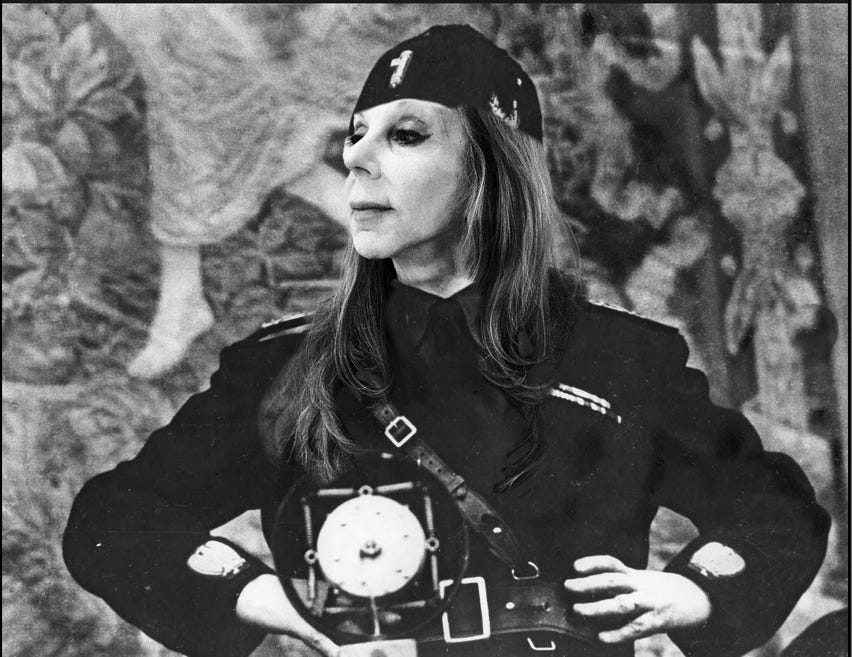
(Self-Portrait?)
The other day I said to my husband, “I think I’m becoming wiser.”
“What makes you say that?” he asked.
“I just read the nastiest review I’ve ever received in my life, and it doesn’t bother me.”
“How nasty?”
“He ends by calling me a totalitarian!”
My husband looked horrified, but when I started laughing he joined in.
While reading the review, he laughed several more times, including at its first sentence: “I know nothing about how the world works.” The suggestion is that neither do we, despite our pretensions to the contrary. But the reviewer, unlike us dupes, doesn’t accept science. He used to, he explains, but then he met some scientists and failed to be impressed. Why? They haven’t yet produced a unified field theory. “Until this hypothetical key to the mysteries puts a bow on string theory and reconciles quantum and classical mechanics, don’t bother” trusting science. (In fact, as most physics undergraduates know, quantum and classical mechanics are successfully reconciled, the latter being the limiting case of the former. Presumably the author was confused by a vague recollection that relativity theory and quantum mechanics await reconciliation, or the related idea that Einstein and his successors failed to develop a field theory that unifies gravity with the other fundamental forces. The problems of physics get progressively more difficult precisely because of the advances in our knowledge which carry us ever deeper. And anyway, what do problems in the most abstruse frontier of physics have to do with the rest of science?)
Equally worthless, concludes our critic, is philosophy. He once went to a dinner party where everyone else was a philosopher and, again, he failed to be impressed.
You might be aghast at this contempt for knowledge. But I commend the critic for being so open about his closed mind.
In rejecting both science and philosophy, the critic was left with little to discuss about the contents of The Mattering Instinct. He solved the problem by misunderstanding a linguistic aside I make about the English word matter, inflating it in his mind into my instrument of deduction. “Ms. Goldstein’s step from the physical ‘science of matter’ to psychological and social ‘mattering’ proceeds along the narrowest of linguistic paths.”
It’s true that I remark that the English word matter is used as both a noun referring to the stuff of the physical universe and as a verb referring to deserving of attention. It’s a happy accident of English, I say, since it provides us Anglophones with a pithy expression of my major assertion: “We are creatures of matter who long to matter.” But I don’t base the truth of this sentence on the etymological quirks of this English word. I don’t base any truths on the etymological quirks of a word! True, some philosophers do this: Heidegger employs etymology to “uncover Being,”—favoring Greek and German as “privileged languages”— but I’ve always stayed as far away from such tactics (and from Heidegger) as I can. But since this critic must, according to his scruples, ignore the science and philosophy by which I pass from the science of matter to our human longing to matter (however you refer to those concepts), and must moreover fulfill his word count, he goes on to flaunt his knowledge of French and German and their unsurprising failure to replicate the noun-verb polysemy of the English word matter, offering it as a refutation to his misunderstanding of my argument.
But the real baffler came in the charge of totalitarianism, which doesn’t come until the last paragraph, which we will get to.
One philosopher colleague conjectured that the critic may have been misled by reading the title of my previous book, Plato at the Googleplex. The book did bring Plato to life to discuss his ideas, and the man has often been charged, with some justification, with totalitarianism. But in the book, I gave Plato a hard time about that part of his thinking, which is irrelevant either way since the critic shows no sign of having read it. After all, it was philosophy, and that dinner party had proved that philosophy was useless.
Rather it seems my inner totalitarian revealed itself to the critic in the following sentence, which he quotes verbatim with a personal insertion: “’The most pragmatic, not to say moral, thing that we’—i.e., the government—’could do for society is create enough mattering to go around, providing for all what ought to have been the birthright of having been born.’”
His intruding id est, “the government,” is revealing. Nowhere in the book do I advocate, in either assertion or implication, what he calls “state-mandated mattering,” the basis for his final verdict: “The word for universal state-mandated mattering is much the same in most languages: totalitarianism.”
We are left with the riddle of why he hallucinated an equation of “we” with “the government,” and of justified mattering with state-mandated mattering. I do have my political views, of course, but I didn’t appeal to them, or to politics of any kind, in the book, trying as hard as I could to find values on which people of many political, as well as religious, persuasions could agree. I abhor the rampant politicizing of contemporary life.
Instead of politics, I appealed to ethics. Perhaps the critic, dismissive as he is of philosophy, couldn’t believe I’d be so naïve as to appeal to ethics—indeed, doubly naïve, for (1) who could believe that there is such a thing as objective ethics, and (2) even granting such an improbability, who could believe that ethics could change our behavior, much less impact society? Perhaps that’s what emboldened him to put those words in my prose, to make explicit what he imagined that I—presumably the kind of Marxist he might picture running wild through academia — was disingenuously masking.
But, in fact, I do believe there is such a thing as objective ethics, and that fundamental to it is the truth that all humans intrinsically matter—none of us more nor less than others—and ought to be treated accordingly. And I do believe that acknowledging this objective moral truth can motivate behavior, sometimes on a scale that can impact society. The critic may think that ethics is either non-existent or impotent. But I disagree.
I can single out certain historical events as demonstrating this potency. Here in our sadly divided USA, we are about to celebrate one of these events, the 250th anniversary of the signing of the Declaration of Independence, which declared, as a “self-evident truth,” the birthright of us all to life, liberty, and the pursuit of happiness.[1]
“There is no birthright to matter,” writes the critic (who happens to be British, but no hard feelings). Our founders disagreed, and on that ethical foundation built their political movement, rather than retrofitting their ethics to justify the current political regime.
So where did this topsy-turvy attribution come from? Though The Mattering Instinct was politically nonpartisan, the reviewer, a man of the right, writing in a right-wing outlet, may have sniffed out that I am not a conservative. There is a paranoid strain in traditional conservatism in which anyone to the left of Ayn Rand must be a regulation-loving, economy-directing bureaucracy-expanding, school-curriculum-rewriting statist, and the reviewer appears to be projecting that demon onto me.
Ironically, he seems oblivious to another strain of traditional conservatism in which moral commitments are spread through non-governmental channels such as art, social and moral norms, religion and other civil society institutions, and the conventional decency of the day. It did not occur to him that my arguments could be realized in any of these ways.
In contemporary American conservatism we’re also seeing a return to a paleoconservative hostility to intellectuals and experts, manifest in the critic’s flippantly blowing off all of philosophy and science.
But to return to my remark to my husband, regarding my becoming wiser. What I’d meant was that for all the review’s snipes and snarks, not to speak of falsifications, it didn’t upset me. I, who used to suffer so severely from fear of others’ judgments, didn’t take it personally. I simply sought to make sense of it. And this is closer to wisdom than I’ve ever been.
What this equanimity suggests is that my mattering project is working for me. At this point in my life, my greatest wish is to aid others to find mattering projects that work for them, and in so working make them less inclined to try to matter by making others feel that they don’t matter. How tired of these belittlements and dismissals we are, how ready for some way of finding our way back toward openness and mutual respect. How we long for a civil society, where we try to interpret others as generously as is compatible with their words and deeds and, in being seen in more generous terms than we perhaps deserve, be motivated to deserve them. Can’t we strive to bring out the best in one another instead of the worst?
And I include, among all others whose own mattering I hope will be secured on psychologically healthy and expansively moral foundations, the dismissive critic.
[1] I’m grateful to Lachlan Forrow for pointing out that the central ethical claim of The Mattering Instinct is one with the central ethical claim of the Declaration of Independence.
This is deliciously wise (and quietly lethal). The opening exchange with your husband is the perfect palate cleanser before you calmly dissect a review that’s basically “I distrust science because I once met a scientist at a party.”
I love how you refuse to take the bait emotionally and instead treat the whole thing like an odd little specimen under glass: observe, identify, contextualize, move on. And the best part is the reversal at the end, where the real point isn’t “look how wrong he is,” but “look how much freer I am now.”
Also: calling a book about human mattering totalitarian is such a category error it practically deserves its own Nobel Prize in Missing the Point.
That final note of generosity toward even the critic is the mic drop. Not because you let him off the hook, but because you don’t hand him the keys to your nervous system.
Rebecca, you are far cooler than I would be. The WSJ reviewer proudly proclaims his ignorance in the first sentence--revealing not only that he doesn't know about science and philosophy but he doesn't care--and the review somehow goes downhill from there to its final offensive, baffling verdict. Why would the Journal publish this crap? Except perhaps to drum up a phony little controversy? Ugh. John